


Page 63 - iScience K to 12 Curriculum Series
P. 63
U
                  There are ways by which electric charges  Examples:                                             N
              flow. The two processes by which electric                                                           I
              charges flow are called  electron flow and  1.  100 Coulombs of charge flow past a point            T
              conventional  flow. Electron flow occurs            in  20  seconds. What is the  current  in
              when charges flow from negative to positive         ampere?
              charge. On the other hand, conventional flow                                                       1
              happens when  charges  flow from positive           Given:
              charge to negative charge.                              Q = 100 Coulomb
                                                                       t  = 20 seconds                           2
              Current
                                                                  Find: I                                        3
                  Electric current exists whenever an electric
              charge is being transferred from one point to       Formula:
              another in a given place.                                I =  Q                                    4
                                                                           t
                  Current  is the net  flow of charge  at a       Solution:
              certain period of time. It is measured in terms              100C
              of ampere,  a unit  named after  André-Marie             I =  20 s
              Ampère. An ammeter measures  the amount                       C
              of current that flows in an electric circuit.            I = 5  s
                                                                       Or 5 A


                                                              2.   A charge of 0.8 passes through a wire in 4
                                                                  seconds. What is the current in it?

                                                                  Given:
                                                                       Q = 0.8C
                                                                        t  = 4 seconds

                                                                  Find: I

                                                                  Formula:
                                                                           Q
                                                                       I =
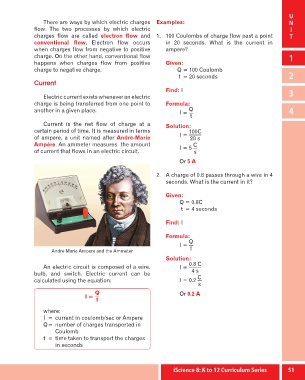
                     Andre-Marie Ampere and the Ammeter                    t
                                                                  Solution:
                  An electric circuit is composed of a wire,           I =  0.8 C
              bulb, and switch. Electric current  can be                    4 s
              calculated using the equation:                           I = 0.2  C
                                                                              s
                                      Q                                Or 0.2 A
                                  I =  t


                  where:
                  I  =  current in coulomb/sec or Ampere
                  Q =  number of charges transported in
                       Coulomb
                  t  =  time taken to transport the charges
                       in seconds


 50  iScience 8: K to 12 Curriculum Series                           iScience 8: K to 12 Curriculum Series       51

