


Page 16 - iScience K to 12 Curriculum Series
P. 16
U       getting into your lungs.  Air  from the  larynx  This process of breathing is inhalation.
      N       enters the trachea through an opening known
      I       as the glottis. It is supported  by  C-shaped      During    inhalation,   the    diaphragm
      T       cartilage  rings,  which  ensure  it  is  always  contracts and moves down, and the rib cage
              kept  open.  The  lower  end  of  the  trachea  moves up.  When  the  chest  expands,  the  air
              divides into two tubes, the bronchi (singular:  pressure in the chest cavity drops causing air
     1        bronchus), one for each lung. The bronchus  to rush into the lungs.
              divides into smaller tubes called bronchioles.
     2        The bronchioles end in clusters of tiny air sacs
              or alveoli inside the lungs. The alveolar walls
              are thin, moist, and well-supplied with blood
     3        capillaries, all perfect for gaseous exchange.

                 The lungs lie in the upper chest cavity. The
     4        lungs are divided into sections called lobes.
              Each lung lies in the pleural cavity; it’s almost
              filled  when both lungs expand. The pleural
              cavity is lined with a transparent elastic
              membrane called pleura that encloses each
              lung. The airways in the lungs end into millions
              of tiny air sacs called  alveoli. A network of
              capillaries covers each alveolus. The oxygen
              diffuses  from the  air  in  the  alveoli  into the
              blood. Capillaries in the body tissue carry out
              oxygen to all parts of the body cell. This body
              cell  produces carbon dioxide and is mixed
              with the blood. The ribs support the chest wall
              to protect the lungs from mechanical injury.
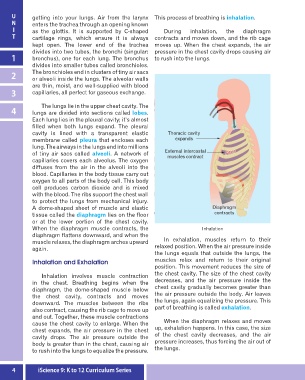
              A dome-shaped sheet of muscle and elastic
              tissue called the diaphragm lies on the floor
              or at the  lower  portion of the  chest  cavity.
              When  the  diaphragm muscle  contracts,  the                      Inhalation
              diaphragm flattens downward, and when the
              muscle relaxes, the diaphragm arches upward        In exhalation, muscles return  to their
              again.                                         relaxed position. When the air pressure inside
                                                             the lungs equals that outside the lungs, the
              Inhalation and Exhalation                      muscles relax and return to their  original
                                                             position. This movement reduces the size of
                 Inhalation involves muscle contraction      the chest cavity. The size of the chest cavity
              in the chest. Breathing  begins when the       decreases,  and the  air  pressure  inside  the
              diaphragm, the  dome-shaped muscle  below      chest cavity gradually becomes greater than
              the  chest cavity, contracts and moves         the air pressure outside the body. Air leaves
              downward. The  muscles  between  the  ribs     the lungs, again equalizing the pressure. This
              also contract, causing the rib cage to move up   part of breathing is called exhalation.
              and out. Together, these muscle contractions
              cause the chest cavity to enlarge. When the        When  the  diaphragm  relaxes  and  moves
              chest expands, the air pressure in the chest   up, exhalation happens. In this case, the size
              cavity drops. The air pressure outside the     of  the  chest  cavity decreases,  and  the  air
              body is greater than in the chest, causing air   pressure increases, thus forcing the air out of
              to rush into the lungs to equalize the pressure.   the lungs.


      4         iScience 9: K to 12 Curriculum Series                                                                                                                                   iScience 9: K to 12 Curriculum Series        5

